
Semrush Review: A Complete Look at the SEO and AI Visibility Platform
What Semrush Is and Who It's For
Semrush is an online visibility platform built for SEO, paid search, content marketing, competitive research, and, increasingly, brand visibility inside AI-generated answers. It pulls together keyword data, backlink analysis, site audits, rank tracking, and competitor intelligence into one workspace, which is why this Semrush review treats it as an all-in-one suite rather than a single-purpose tool. The company launched in 2008, went public on the New York Stock Exchange in 2021 under the ticker SEMR, and was acquired by Adobe in a $1.9 billion deal that closed in April 2026.
The platform serves a broad audience: solo bloggers and freelancers running one or two sites, in-house marketing teams, and agencies managing dozens of client accounts. Its proprietary dataset is one of the largest in the category, spanning tens of billions of keywords and trillions of backlinks, and it now tracks how brands surface across Google alongside AI platforms like ChatGPT, Gemini, and Perplexity. That dual focus, traditional search plus AI search, is the main thing setting current Semrush apart from older keyword-only tools.
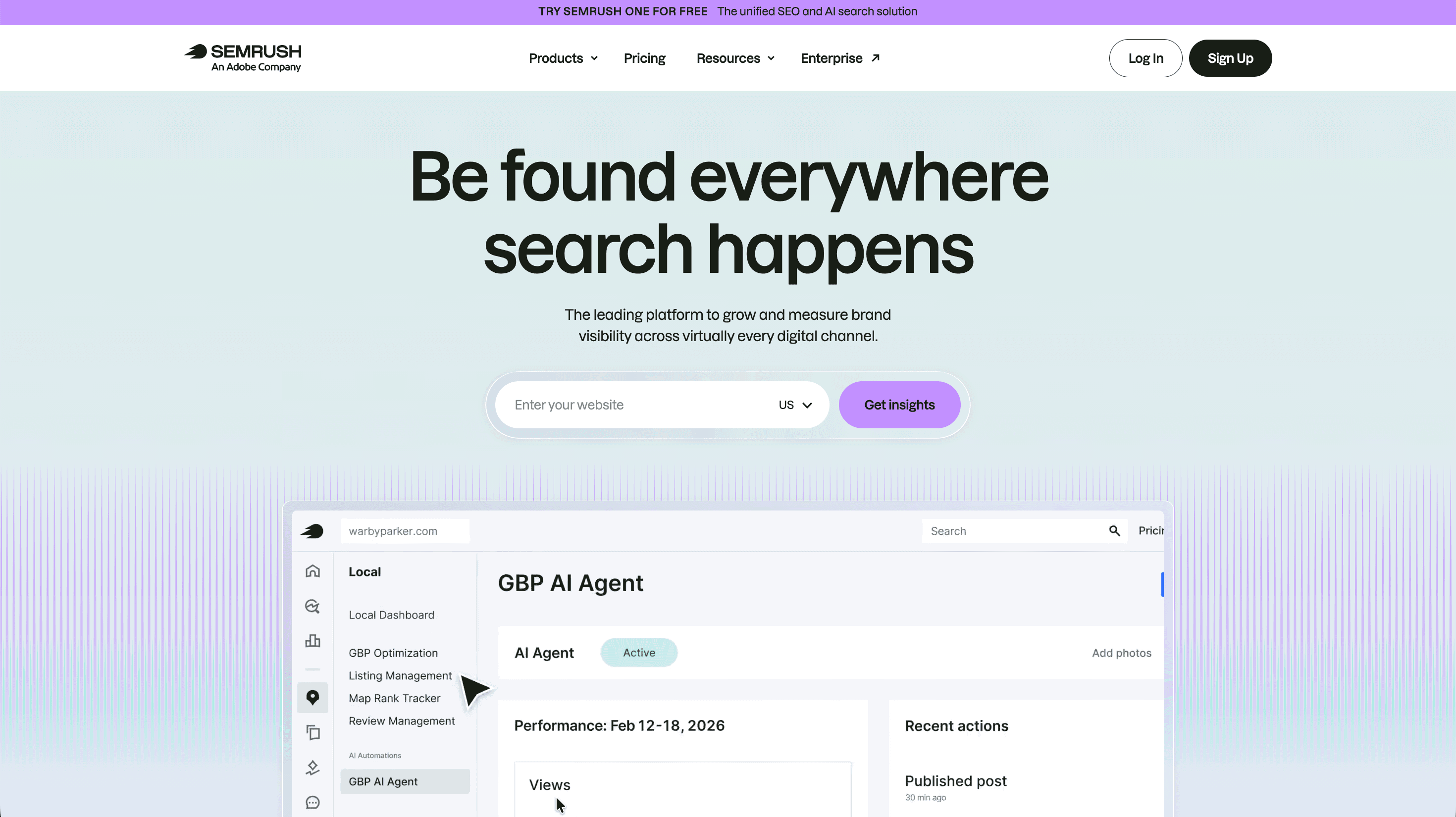
What you actually get depends heavily on your plan, and the difference between tiers is often a hard feature gate rather than just a higher limit. That distinction matters throughout this review.
| Detail | Information |
|---|---|
| Website | semrush.com |
| Developer | Semrush (an Adobe company) |
| Launched | 2008 |
| Supported platforms | Web, iOS, Android (desktop via browser) |
| Free plan / trial | Free account with limited daily queries; 7-day trial on paid plans |
| Primary purpose | SEO, AI search visibility, competitive analysis, content and PPC research |
Is Semrush Safe and Reliable?
Semrush is a publicly traded company headquartered in Boston, with offices across North America, Europe, and Asia and a global user base in the tens of millions. As a data processor, it maintains a formal security program that's documented publicly. The platform holds SOC 2 Type II certification audited annually, and is described across vendor risk profiles as ISO 27001, PCI, GDPR, and CCPA compliant. Its founders relocated from Russia to the United States in 2017, and the company ceased operations in Russia following the 2022 invasion of Ukraine.
On the technical side, Semrush stores service data in physically secure US data centers operated by AWS, Google Cloud, and Digital Realty. Passwords are stored encrypted, internal applications handling critical data use single sign-on and two-factor authentication, and HTTPS (TLS) encryption is applied across all login interfaces. When data is copied outside a data center it's encrypted, and access to user data is limited to a controlled subset of staff for support and security purposes. The company maintains documented breach procedures, a data processing addendum for business customers, and a published sub-processor list.
| Security parameter | Details |
|---|---|
| Compliance | SOC 2 Type II (annual audit), ISO 27001, GDPR, CCPA, PCI |
| Encryption | TLS/HTTPS in transit; encrypted password storage; encryption of data moved outside data centers |
| Authentication | SSO and 2FA on internal critical systems; 2FA available to users |
| Hosting | AWS, Google Cloud, Digital Realty (US data centers) |
| Data rights | Subject access request handling, sub-processor transparency, DPA available |
Reputation is more divided, and an honest review has to acknowledge the split. On professional software platforms the product earns strong marks, around 4.5 out of 5 on G2 across more than 3,400 reviews and 4.6 on Capterra across roughly 2,300. Trustpilot tells a different story, with a score closer to 2 driven almost entirely by billing and cancellation complaints rather than product quality. That gap reflects who's reviewing where: working professionals rate the tools highly, while the lowest scores cluster around subscription friction. The takeaway is that the platform itself is well regarded and the security posture is solid, but the commercial experience around renewals and cancellations deserves genuine caution, a point covered more in the pricing section.
Core Features and What They Do
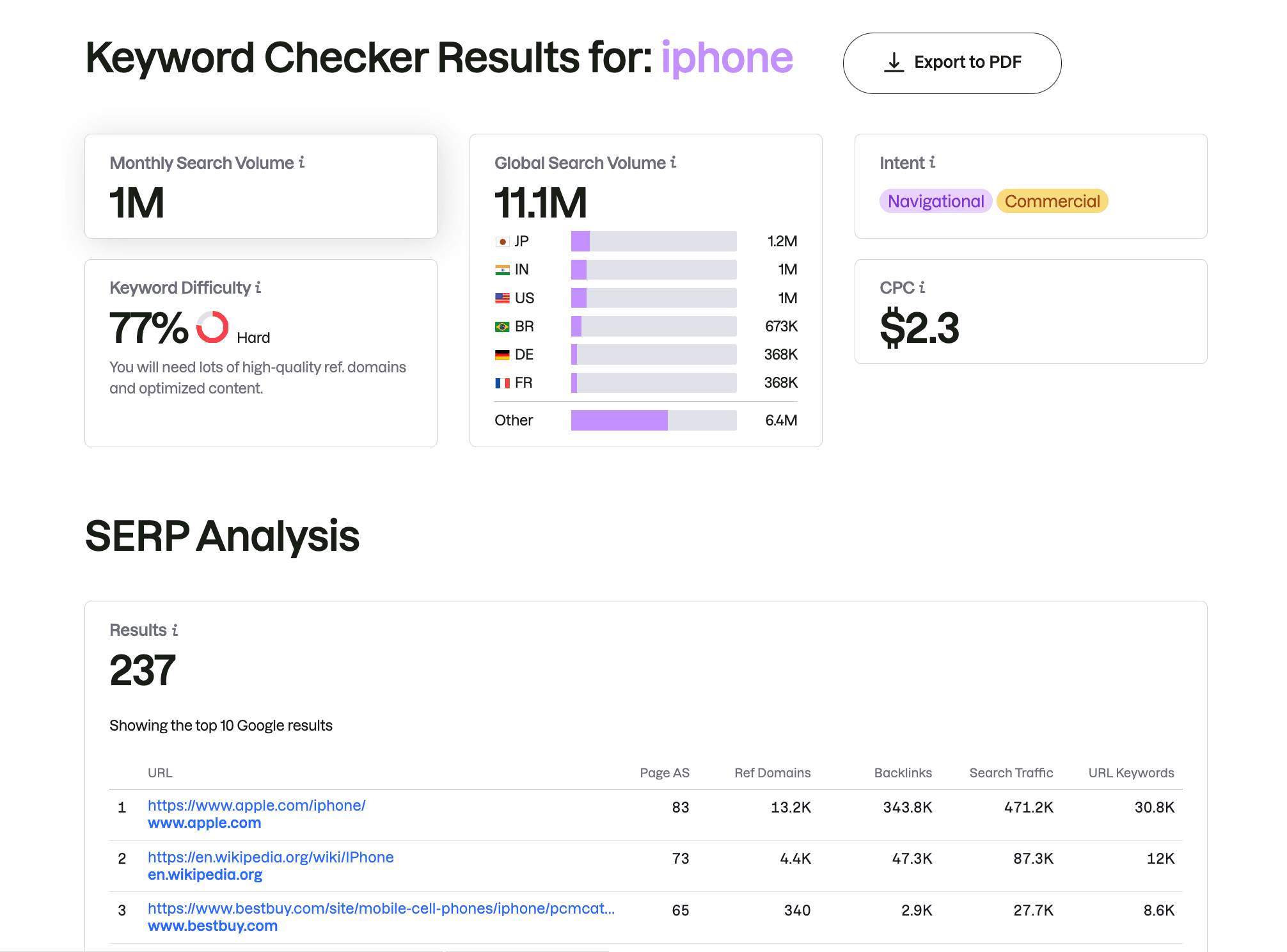
Semrush bundles more than 55 tools, and the depth in a few areas is what users consistently single out. Keyword research runs through the Keyword Magic Tool and Keyword Overview, returning search volume, difficulty, intent, and global breakdowns by country. The platform layers AI on top with Personal Keyword Difficulty, which scores how realistically your specific domain could rank, and Topical Authority, which gauges whether your site already has relevance in a topic.
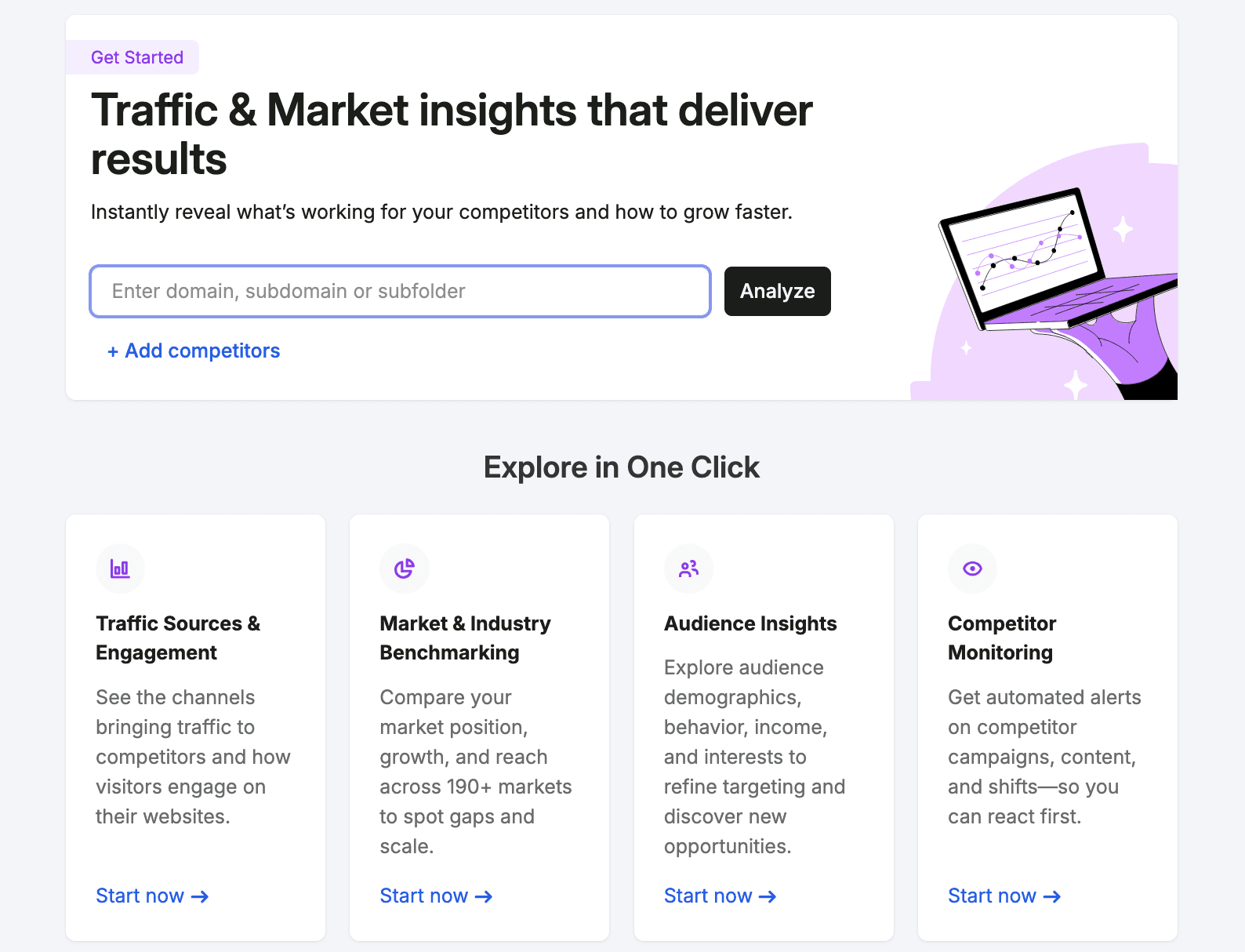
Competitive analysis is a second pillar. Domain Overview, Organic Research, Keyword Gap, and Backlink Gap let you see any competitor's organic keyword profile, estimated paid spend, top pages, and link sources, which is the feature many reviewers say justifies the subscription on its own. The Traffic & Market toolkit extends this with traffic source breakdowns, audience demographics, market benchmarking across 190-plus markets, and competitor monitoring alerts.
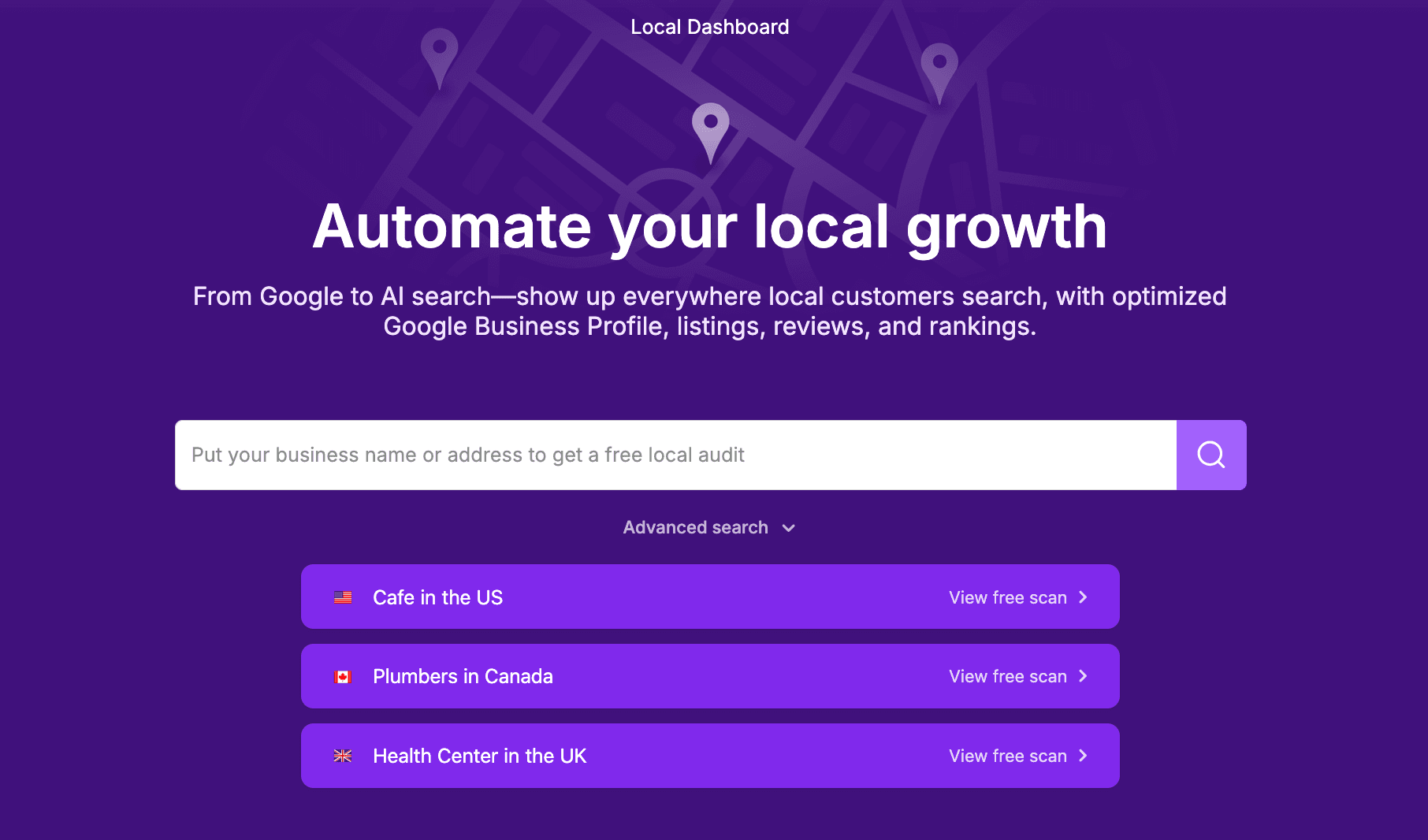
The technical side centers on Site Audit, which crawls a site against more than 200 checks to flag broken links, indexability problems, slow pages, and Core Web Vitals issues, and now includes AI search site health to catch problems blocking AI bots from citing your content. Position Tracking monitors keyword rankings over time across locations and devices, while the Backlink Analytics and link-building tools audit link profiles, surface toxic links, and find outreach prospects. Rounding it out are a Content Marketing toolkit (topic research, SEO content templates, the SEO Writing Assistant), a Local toolkit covering Google Business Profile optimization and map rank tracking, an Advertising toolkit for PPC research, and an AI Visibility toolkit that measures how your brand appears in answers from ChatGPT, Gemini, Perplexity, and Google's AI surfaces.
A practical caveat from real-world use: traffic and volume figures are Semrush's own modeled estimates, not pulled directly from Google. For lower-volume keywords they can diverge from Google Search Console, so the data is best treated as directional for competitive comparison rather than absolute truth.
Semrush Pricing and Plans
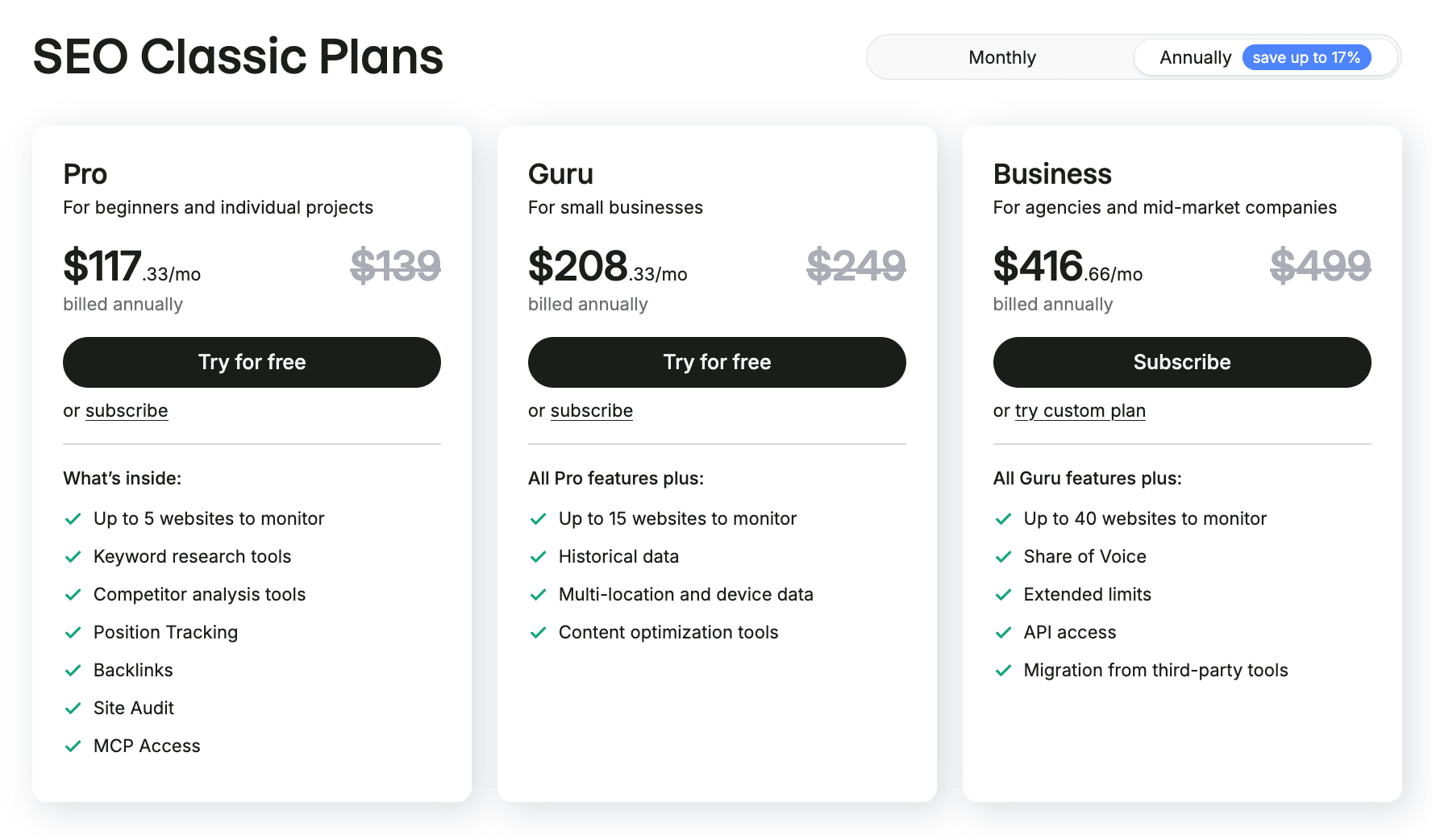
Pricing is where buyers need the most clarity, because the headline numbers don't tell the whole story. The classic SEO lineup has three tiers, each billable monthly or annually, with annual billing saving roughly 17%. There's also a free account with heavily limited daily queries (around 10 results per report and 10 reports per day) and a 7-day trial on paid plans.
| Plan | Monthly price | Annual price (per mo.) | Projects | Keywords tracked | Pages audited/mo. | Key additions |
|---|---|---|---|---|---|---|
| Pro | $139.95 | $117.33 | 5 | 500 | 100,000 | Core SEO, keyword research, competitor analysis, site audit, 1 user seat |
| Guru | $249.95 | $208.33 | 15 | 1,500 | 300,000 | Content Marketing toolkit, historical data, multi-location tracking, branded reports, 3 seats |
| Business | $499.95 | $416.66 | 40 | 5,000 | 1,000,000 | API access, Share of Voice, white-label reports, extended limits, 5 seats |
Two things catch people off guard. First, the jump from Pro to Guru is a feature gate, not just bigger limits: historical data and the full Content Marketing toolkit simply don't exist on Pro, so you can't work around it by using fewer projects. Second, the published price rarely reflects the real cost for a team. Pro includes only one seat, with extra seats running roughly $45 each per month, and the platform sells a menu of add-ons on top, including the Trends toolkit (around $289/month), the AI Visibility toolkit ($99/month per domain), Local ($30–$60 per location), Social ($20/month and up), and Advertising ($99/month). A fully loaded Guru account for a small team can climb past $600/month.
Alongside the classic plans sits Semrush One, a newer bundle that combines the SEO toolkit with AI visibility tracking. It runs $199/month for Starter, $299/month for Pro+, and $549/month for Advanced, aimed at teams that want both Google and AI-answer monitoring in one subscription. For organizations needing custom data limits, multi-team governance, and dedicated support, Semrush for Enterprise offers custom-priced SEO, AI Optimization, and Site Intelligence products.
One financial caution worth flagging before you enter a card: the cancellation process has drawn consistent complaints. Refunds are limited to a one-time 7-day window on initial annual purchases, monthly subscribers who cancel mid-cycle generally aren't refunded, and several users report being charged after believing they'd cancelled. Setting a calendar reminder before a trial ends is sensible.
Integrations and API
Semrush connects to the wider marketing stack mainly through the Google ecosystem and a set of native connectors. You can link Google Analytics and Google Search Console to analyze your site's data inside the Semrush interface, connect Google Ads for campaign tools and reporting widgets, and tie in Google Business Profile for local data. Looker Studio connectors let you pull Domain Analytics, Position Tracking, and Site Audit data into custom dashboards, though these connectors require a Guru or Business subscription. Reporting data also exports to Google Sheets.
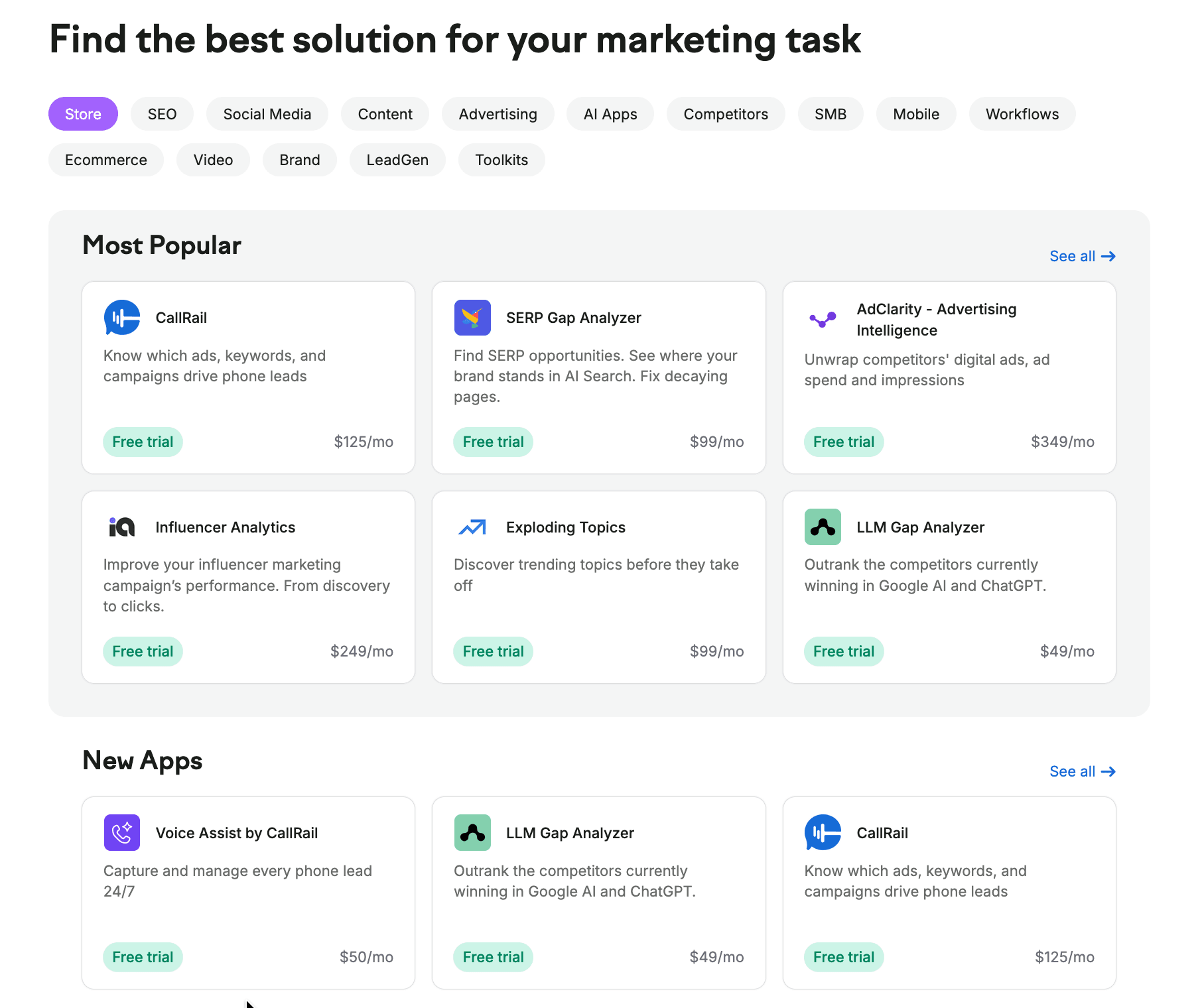
On the social side, Facebook, Instagram, LinkedIn, Pinterest, and YouTube connect to the Social Poster and Social Tracker for scheduling and competitive tracking. Beyond Google, native integrations include monday.com for managing SEO tasks with live keyword data, the All in One SEO (AIOSEO) WordPress plugin, Zoho Analytics, and Zapier for broader automation. The App Center adds third-party and Semrush-built apps covering everything from call tracking to AI gap analysis.
For programmatic access, the API is gated to the Business plan (or Semrush One Advanced). Even after upgrading you start with zero standard API units and buy them in packages, billed by consumption: a line of live organic keyword data costs about 10 units, historical data 50, so large pulls add up quickly on top of the subscription. Separately, Semrush ships an official MCP server that connects its data to AI assistants like Claude, ChatGPT, Gemini, Cursor, and Claude Code. MCP access is unusually broad here, included on paid SEO plans with 50,000 units for that use, and it provides read-only access to organic, keyword, backlink, and trends research through natural-language queries.
Platforms and Apps
Semrush is fundamentally a web application, and that's where the full toolset lives. There's no dedicated Windows, Mac, or Linux desktop program; the platform runs in the browser on any operating system. The depth of research, auditing, content work, and reporting is designed for a desktop screen, and that's the realistic place to do serious work.
Mobile apps exist for both iOS and Android, but they're focused rather than comprehensive. The mobile experience centers on Position Tracking, letting you check daily ranking movements, see which positions you've won or lost in Google's top 3, 10, 20, or 100, and view visibility, traffic, and average-position trends over a chosen date range. Using the app requires a Position Tracking campaign already set up on the web. App Store reviewers like the convenience of checking rankings on the go but consistently wish the app carried more of the platform's tools, and that's a fair summary: treat mobile as a monitoring companion, not a substitute for the desktop interface. There's also a browser extension, SEOquake, for analyzing on-page and SERP metrics directly in Google search results.
Getting Started with Semrush
Creating an account and running your first analysis takes only a few minutes, even before deciding on a paid plan. The sign-up flow is straightforward.
- Go to semrush.com and select Sign Up in the top right.
- Enter your email and create a password, or register with a Google account.
- Confirm your email address if prompted to activate the account.
- Choose whether to start on the free account or begin a 7-day trial of a paid plan (the trial requires card details).
- Create your first Project by entering your domain, which unlocks Site Audit and Position Tracking for that site.
- Connect Google Analytics and Search Console if you want your own performance data inside the dashboard.
- Run an initial query, a Domain Overview or a Keyword Magic Tool search, to start pulling data.
The interface organizes everything under Projects, and using that structure from the start keeps work for each site or client separate and easier to navigate. New users have a real learning curve to expect, since the sheer number of tools is the most common early complaint, so the free Semrush Academy courses and certifications are a genuinely useful on-ramp.
Support and Contact Options
Support depth scales with your plan, which is an important detail. Free-account users can reach the team only for non-product questions like billing, account, and legal matters; product-specific help is reserved for paid subscribers. Paid users get personalized support across product questions through live chat and email, alongside an extensive self-service layer.
| Channel | Details |
|---|---|
| Live chat | Available to paid users via the website for real-time help |
| mail@semrush.com; responses can take two to three business days during high volume | |
| Phone | Region-specific lines (US, UK, Canada, Australia, France, Italy, Spain), business hours |
| Knowledge Base | User manuals, how-tos, FAQs, and videos for every tool |
| Academy | Free courses, certifications, and exams used by hundreds of thousands of marketers |
| Webinars | Live and on-demand sessions on tools and strategy |
| Social | Support and updates via Facebook, X (Twitter), and LinkedIn |
The self-service resources are a real strength, the Knowledge Base and Academy are thorough, and many questions resolve there without contacting anyone. Where experiences vary most is billing-related support; resolution quality on refunds and add-on disputes is the recurring sore point in critical reviews, so for those specific issues it's worth being clear, documented, and persistent.
Semrush Pros and Cons
Pros
- +Huge databases: 25B+ keywords and 43T+ backlinks.
- +All-in-one platform with 50+ tools beyond just SEO.
- +Excellent competitor analysis and content gap research.
- +Generous reporting limits compared to rivals.
- +Strong PPC, content marketing, and social tools.
Cons
- –Expensive, especially as costs add up.
- –Only one user seat included per plan.
Frequently Asked Questions
What is Semrush used for?
It's an all-in-one platform for keyword research, competitor analysis, site audits, rank tracking, backlink analysis, content optimization, PPC research, local SEO, and tracking brand visibility in AI-generated answers.
Is there a free version?
Yes. A free account gives limited daily access, roughly 10 results per report and 10 reports per day, enough for basic exploration but not professional work. Paid plans add a 7-day trial.
How much does the platform cost?
The classic SEO plans are $139.95/month (Pro), $249.95/month (Guru), and $499.95/month (Business), with annual billing cutting each by about 17%. The Semrush One bundles start at $199/month. Add-ons and extra seats raise the real cost.
Which plan is the best value?
For most serious users, Guru is the sweet spot, since it unlocks the Content Marketing toolkit, historical data, and three user seats. Pro suits solo users with simple needs, and Business makes sense once you need API access, Share of Voice, or the highest limits.
Is the platform safe to use?
It maintains SOC 2 Type II certification with annual audits, is GDPR and CCPA compliant, encrypts data in transit, and hosts on major cloud providers. Product reviews are strong; the main complaints concern billing and cancellation rather than security.
Does Semrush have a mobile app?
Yes, for iOS and Android, but it's focused on Position Tracking and ranking monitoring rather than the full toolset. Detailed research is best done in the web interface.
Can I connect it to other tools?
It integrates with Google Analytics, Search Console, Ads, and Business Profile, plus Looker Studio, Google Sheets, monday.com, Zapier, AIOSEO, and social networks. An official MCP server connects its data to AI assistants.
How accurate is the keyword data?
Volume and traffic figures are modeled estimates, not pulled directly from Google. They're reliable for competitive comparison but can diverge from Google's own numbers on low-volume keywords.
Does it require a long-term contract?
You can pay monthly or annually. Refunds are limited to a one-time 7-day window on initial annual purchases, and cancellation requires completing a form plus an email confirmation, so it's worth setting a reminder before any trial or renewal date.
Who owns Semrush?
Adobe completed its $1.9 billion acquisition of the company in April 2026, making it an Adobe subsidiary, though it continues to operate as Semrush.